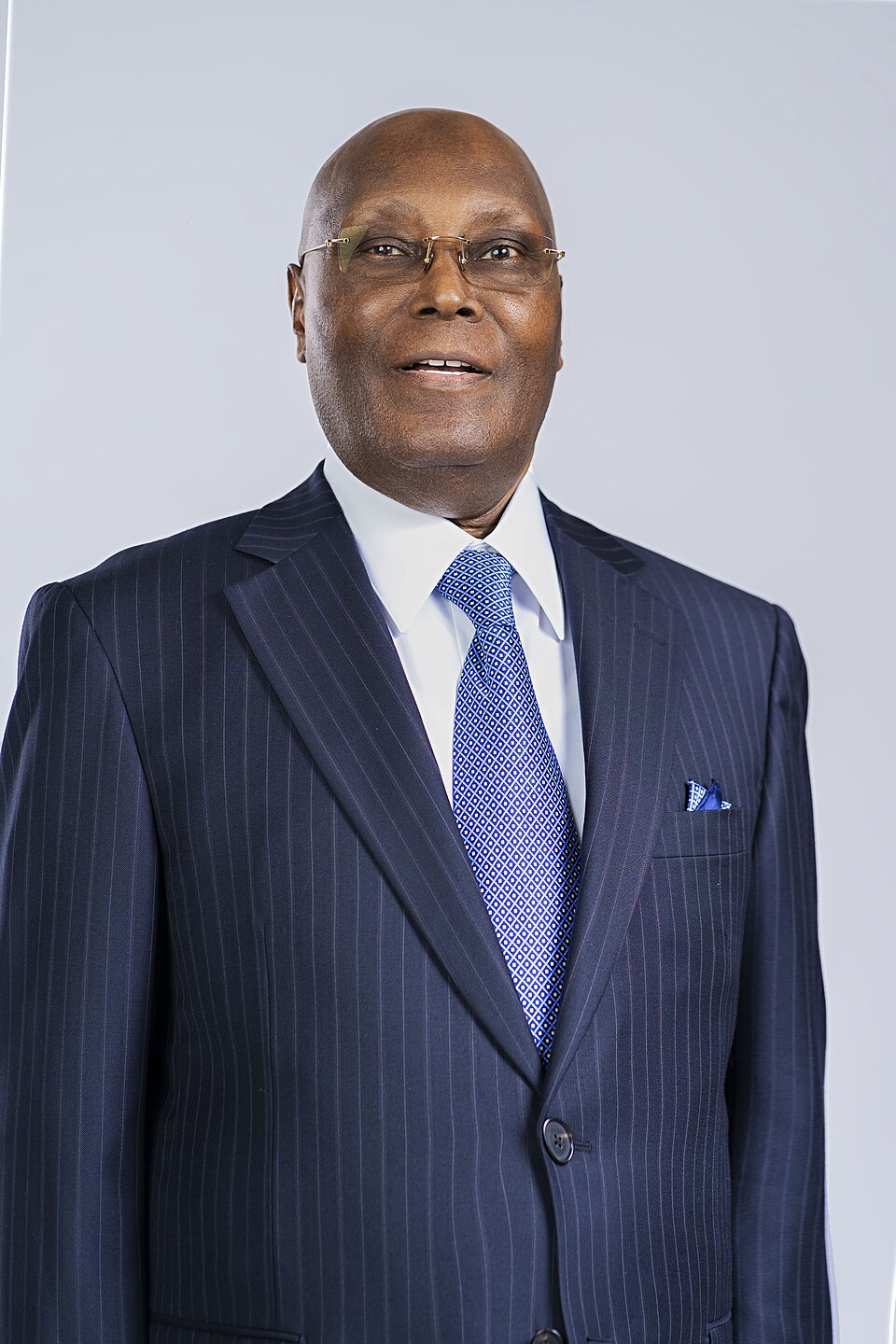
Atiku Abubakar is a former Vice-President of Nigeria and one of the country’s longest-serving opposition figures. A customs officer turned businessman, he served two terms alongside President Olusegun Obasanjo from 1999 to 2007, fell out with him over the “third term” plan, and has run for president several times since. He finished second in 2019 and 2023 as the PDP candidate, and in 2027 he is the candidate of the African Democratic Congress (ADC).12
Early life and education
Atiku was born on 25 November 1946 in Jada, in what is now Adamawa State. His father, a Fulani trader and farmer, drowned when Atiku was a child. He attended Adamawa Provincial Secondary School and studied at the School of Hygiene in Kano and the Institute of Administration of Ahmadu Bello University, where he took a diploma in law in 1969. In 2021 he completed a master’s degree in international relations at Anglia Ruskin University.1
Customs career and business
Atiku joined the Nigeria Customs Service in 1969 and rose to deputy director before retiring in 1989. While still in the service he began investing in property and farming, and he co-founded the port logistics company that became Intels, a major oil-services firm. Critics have argued that his business dealings while a public servant created a conflict of interest; he has said his role was limited to holding shares. His other interests include beverages, animal feed and the American University of Nigeria in Yola, which he founded in 2005.1
Early politics
He entered politics in the Third Republic in Shehu Musa Yar’Adua’s People’s Front, which became part of the Social Democratic Party. He came third in the SDP presidential primary of 1993, which M.K.O. Abiola won. In December 1998 he was elected governor of Adamawa State for the PDP, but before taking office he accepted Obasanjo’s offer to be his running mate.1
Vice-President (1999–2007)
As Vice-President, Atiku chaired the National Council on Privatisation, which sold many loss-making state companies. Supporters credit the programme with reforms in telecommunications and other sectors; critics say assets were sold cheaply to well-connected buyers.1
From 2006 his relationship with Obasanjo collapsed after he opposed constitutional changes that would have allowed the president a third term. A Senate committee and the EFCC accused him of mismanaging funds of the Petroleum Technology Development Fund, which he denied. Obasanjo tried to declare the vice-presidency vacant after Atiku joined the Action Congress, but the courts ruled that the president could not remove his deputy that way, and the Supreme Court cleared the way for Atiku to run in 2007.34
Presidential campaigns
- 2007 (Action Congress): He came third with about 7% of the vote and called the election the worst in Nigeria’s history.1
- 2011: He returned to the PDP and lost the primary to President Goodluck Jonathan.1
- 2015: He joined the APC and came third in its primary, won by Muhammadu Buhari.1
- 2019 (PDP): He lost to Buhari by more than three million votes and challenged the result up to the Supreme Court, which dismissed his case.1
- 2023 (PDP): He won the PDP primary with 371 votes, ahead of Nyesom Wike, and came second in the election with 6,984,520 votes. Five PDP governors led by Wike (the “G5”) campaigned against him after he chose Ifeanyi Okowa as running mate. The Supreme Court dismissed his petition in October 2023.15
The ADC and the 2027 ticket
In 2025 Atiku left the PDP and led opposition figures who adopted the ADC as a coalition platform.1 At the party’s primary on 27 May 2026 he won 1,846,370 votes against 504,117 for Rotimi Amaechi and 177,120 for Mohammed Hayatu-Deen.2 Both rivals disputed the result, but in June 2026 the ADC named Amaechi as his running mate.67 Peter Obi, who had also joined the coalition, left to run for the NDC, splitting the opposition. Atiku campaigns on restructuring the federation, privatisation and his experience in government.
Controversies
- US investigations. A 2010 US Senate report on foreign corruption said that one of his wives, Jennifer Douglas, helped move about $40 million in suspect funds into the United States between 2000 and 2008. He was named in the bribery case of US Congressman William Jefferson, who was convicted in 2009. Atiku was never charged and has denied wrongdoing.18
- Renewed scrutiny in 2026. In September 2026 Premium Times reported again on international corruption cases involving Atiku and his former wife. He rejected the report as recycled and politically motivated.9
- Age. He will be 80 by the time of the 2027 election, which opponents have raised as an issue.
Personal life
Atiku has been married several times and has many children. He holds the traditional titles of Turaki and later Waziri of Adamawa. He is a Muslim.1
References
Atiku Abubakar. Wikipedia, accessed October 2026. ↩ ↩ ↩ ↩ ↩ ↩ ↩ ↩ ↩ ↩ ↩ ↩ ↩
Atiku defeats Amaechi, Hayatu-Deen to clinch ADC presidential ticket. TheCable, 27 May 2026. ↩ ↩
Court backs Nigeria vice-president. Al Jazeera, 15 March 2007. ↩
Atiku as monolith of Nigeria’s democracy: a retrospection. ThisDay, 18 July 2023. ↩
Supreme Court dismisses Atiku, Obi’s appeal, affirms Tinubu’s victory. ICIR, 26 October 2023. ↩
ADC names Amaechi as Atiku’s running mate. ICIR, June 2026. ↩
ADC: There’s No Crisis in Our Party over Rotimi Amaechi as Running Mate to Atiku. ThisDay, 25 June 2026. ↩
U.S. Senate report: Abubakar Atiku’s albatross. Vanguard, December 2017. ↩
Atiku speaks on Premium Times report on international corruption cases involving him, ex-wife. AllAfrica, September 2026. ↩