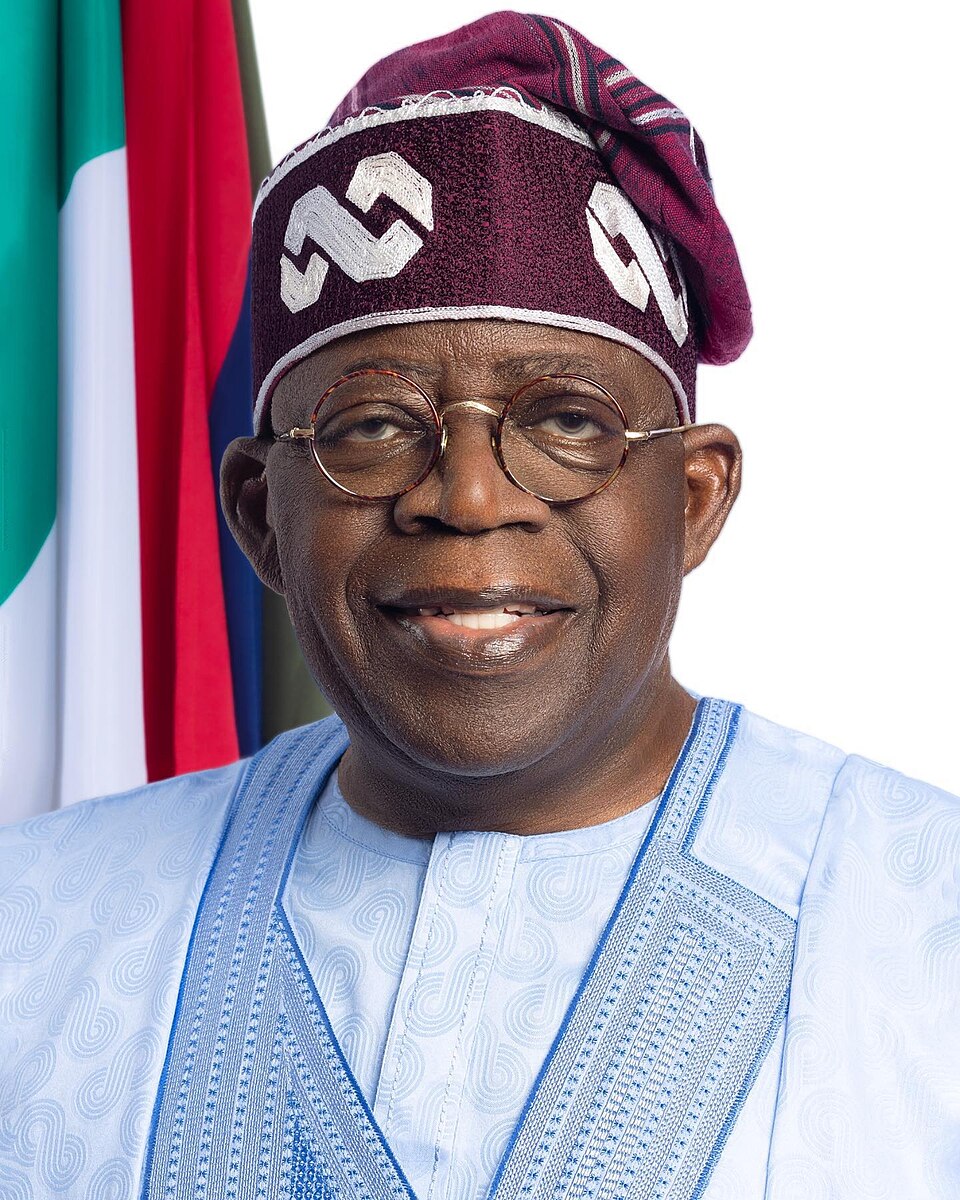
Bola Ahmed Tinubu has been President of Nigeria since 29 May 2023. A former accountant and oil-company executive, he was a senator in the short-lived Third Republic, a pro-democracy campaigner in exile under General Sani Abacha, and governor of Lagos State for two terms. He was one of the architects of the All Progressives Congress (APC), which defeated the governing PDP in 2015, and he won the presidency in 2023 with 36.6% of the vote, the smallest winning share since 1999.1 He is seeking a second term in January 2027.2
Early life and education
Tinubu was born in Lagos, and his officially stated birth date is 29 March 1952. Political opponents have long disputed his age and early schooling, and the record of his primary and secondary education has been the subject of repeated controversy.1 His mother, Abibatu Mogaji, was the Iyaloja (leader of market women) of Lagos until her death in 2013.
He moved to the United States in 1975, studied at Richard J. Daley College in Chicago and then at Chicago State University, where he graduated in 1979 with a degree in business administration.1 During the 2023 election petition, Atiku Abubakar obtained his records from the university through a US court. The university confirmed that Tinubu had graduated, but questions were raised about the certificate he had submitted to INEC; the Supreme Court did not admit the new evidence because it came after the deadline for the petition.34
Business career
After graduating, Tinubu worked as an accountant for Arthur Andersen, Deloitte and GTE Services Corporation in the United States, and later joined Mobil Oil. He returned to Nigeria in the 1980s as a senior executive and treasurer of Mobil Producing Nigeria.1
The Senate and the pro-democracy years
Tinubu entered politics in the Social Democratic Party (SDP) and was elected senator for Lagos West in 1992. When the military annulled the 12 June 1993 presidential election, won by M.K.O. Abiola, and General Abacha dissolved the Senate, he joined the National Democratic Coalition (NADECO), which campaigned for the restoration of democracy. He fled into exile in 1994 and returned after Abacha’s death in 1998.1
Governor of Lagos State (1999–2007)
Elected governor on the Alliance for Democracy (AD) platform in 1999 and re-elected in 2003, Tinubu governed Lagos for eight years. His supporters credit him with modernising the state’s tax administration, which made Lagos far less dependent on federal allocations, and with creating the Lagos Metropolitan Area Transport Authority, which later delivered the BRT bus system and rail projects.1
His tenure was marked by conflict with the PDP federal government under President Olusegun Obasanjo. When Lagos created 37 new local council development areas, the federal government withheld the state’s local government allocations. The Supreme Court ruled that the allocations could not be withheld, and the dispute became an early test of Nigerian federalism.1 In 2007 the federal government brought him before the Code of Conduct Bureau over allegations that he had operated foreign accounts while in office; he denied wrongdoing.1
National party leader
After leaving office, Tinubu built the Action Congress of Nigeria (ACN) into the dominant force in the South-West. In February 2013 the ACN merged with Muhammadu Buhari’s CPC, the ANPP and a faction of APGA, later joined by PDP defectors, to form the APC. Tinubu backed Buhari in 2015 and 2019, and the APC’s 2015 victory ended sixteen years of PDP rule.1
The 2023 election
Tinubu won the APC presidential primary in June 2022 and chose Kashim Shettima, a fellow Muslim and former governor of Borno State, as his running mate, a decision criticised by many Christian leaders. INEC declared him the winner on 1 March 2023 with 8,794,726 votes (36.6%), ahead of Atiku Abubakar of the PDP (6,984,520) and Peter Obi of the Labour Party (6,101,533). He met the constitutional requirement of a quarter of the votes in at least two-thirds of the states.1 Atiku and Obi rejected the result, citing problems with the electronic upload of results and other irregularities. The election tribunal and, on 26 October 2023, the Supreme Court dismissed their petitions.4
Presidency (2023–present)
Economy
In his inaugural address on 29 May 2023 Tinubu declared that the petrol subsidy was “gone”. He later said the announcement was not in his written speech.5 Within weeks the Central Bank, under new leadership after Godwin Emefiele was suspended, removed most restrictions on the foreign exchange market, and the naira lost much of its value.1 Supporters and many economists described the two measures as overdue reforms that ended an expensive and corruption-prone subsidy and a distorted exchange rate. Critics pointed to the result for households: petrol prices multiplied and inflation reached its highest level in nearly three decades in 2024.
The government introduced interest-free loans for students through the Students Loan (Access to Higher Education) Act and the Nigerian Education Loan Fund (NELFUND) in 2024,6 and in July 2024 Tinubu signed a law raising the national minimum wage to ₦70,000 a month.7 In June 2025 he signed four tax reform laws, including the Nigeria Tax Act, which consolidated many federal taxes and changed how revenue is shared and collected.8
Protests
The cost-of-living crisis led to the #EndBadGovernance protests in August 2024. Amnesty International said that security forces killed at least 24 protesters, a figure the police disputed, and a year later said that no one had been held to account.910
Rivers State emergency
On 18 March 2025, citing a long political crisis between Governor Siminalayi Fubara and the State House of Assembly and attacks on oil installations, Tinubu declared a state of emergency in Rivers State, suspended the governor, his deputy and the lawmakers for six months, and appointed a retired naval chief as administrator.11 Lawyers and opposition parties argued that the constitution does not allow a president to suspend elected officials. The emergency rule ended in September 2025, and Fubara returned to office.12
Security and the military
Insecurity, including insurgency in the North-East, banditry and kidnapping in the North-West and attacks on farming communities in the North-Central, remained the main challenge of his first term. In October 2025 Tinubu replaced the service chiefs.13 On 25 December 2025 the United States carried out air strikes against Islamic State targets in north-west Nigeria in cooperation with the Nigerian government, after months of pressure from Washington over killings in the country.14
2027 re-election campaign
The APC held a nationwide direct primary on 23 May 2026, and Tinubu was declared the winner with 10,999,162 votes against 16,503 for his only challenger, Stanley Osifo.2 In July 2026 the party confirmed Kashim Shettima as his running mate again.15 He faces 17 other candidates on INEC’s final list, including Atiku Abubakar (ADC), Peter Obi (NDC) and Seyi Makinde (APM).16
Controversies
- Age and education records. Questions about his date of birth, his schooling and the documents he submitted to INEC have followed him since 1999. He has consistently rejected the claims.13
- 1993 US forfeiture. In 1993 US authorities froze bank accounts linked to him on suspicion that they held proceeds of drug trafficking. The case was settled, and he forfeited about $460,000 without admitting wrongdoing.1
- Appointments. Critics have accused his government of favouring allies and relatives in appointments, including the 2024 appointment of his son-in-law to head the Federal Housing Authority.1
Personal life
Tinubu is married to Oluremi Tinubu, a former senator for Lagos Central, who is First Lady. He has six children, one of whom, Jide, died in 2017. He is a Muslim and holds the traditional titles of Asiwaju of Lagos and Jagaba of Borgu.1
References
Bola Tinubu. Wikipedia, accessed October 2026. ↩ ↩ ↩ ↩ ↩ ↩ ↩ ↩ ↩ ↩ ↩ ↩ ↩ ↩ ↩
Tinubu declared winner of APC presidential primary. Channels Television, 24 May 2026. ↩ ↩
Tinubu’s certificate controversy deepens as CSU fails to confirm authenticity. The Guardian Nigeria, 2023. ↩ ↩
Supreme Court dismisses Atiku, Obi’s appeal, affirms Tinubu’s victory. ICIR, 26 October 2023. ↩ ↩
ICYMI: Subsidy removal was not in my inauguration speech, says Tinubu. TheCable, 2023. ↩
Tinubu signs amended student loan bill into law. ICIR, 2024. ↩
Breaking: Tinubu signs new minimum wage bill into law. Channels Television, 29 July 2024. ↩
New tax regime underway as Tinubu signs bills into law today. The Guardian Nigeria, June 2025. ↩
Nigerian forces killed 24 persons during August protest – Amnesty International. The Guardian Nigeria, 2024. ↩
‘Accountability elusive’ a year after Nigeria protest killings: Amnesty. Al Jazeera, 1 August 2025. ↩
Tinubu declares State of Emergency in Rivers. ICIR, March 2025. ↩
Fubara bounces back as Tinubu lifts emergency rule. ICIR, September 2025. ↩
Tinubu sacks Chief of Defence Staff, other service chiefs. ICIR, October 2025. ↩
US air strikes in Nigeria: Tinubu walks a political tightrope. African Business, December 2025. ↩
2027: APC Confirms Shettima as Tinubu’s Running Mate. ThisDay, 11 July 2026. ↩
INEC publishes final list of presidential candidates for 2027 election. Channels Television, 12 September 2026. ↩
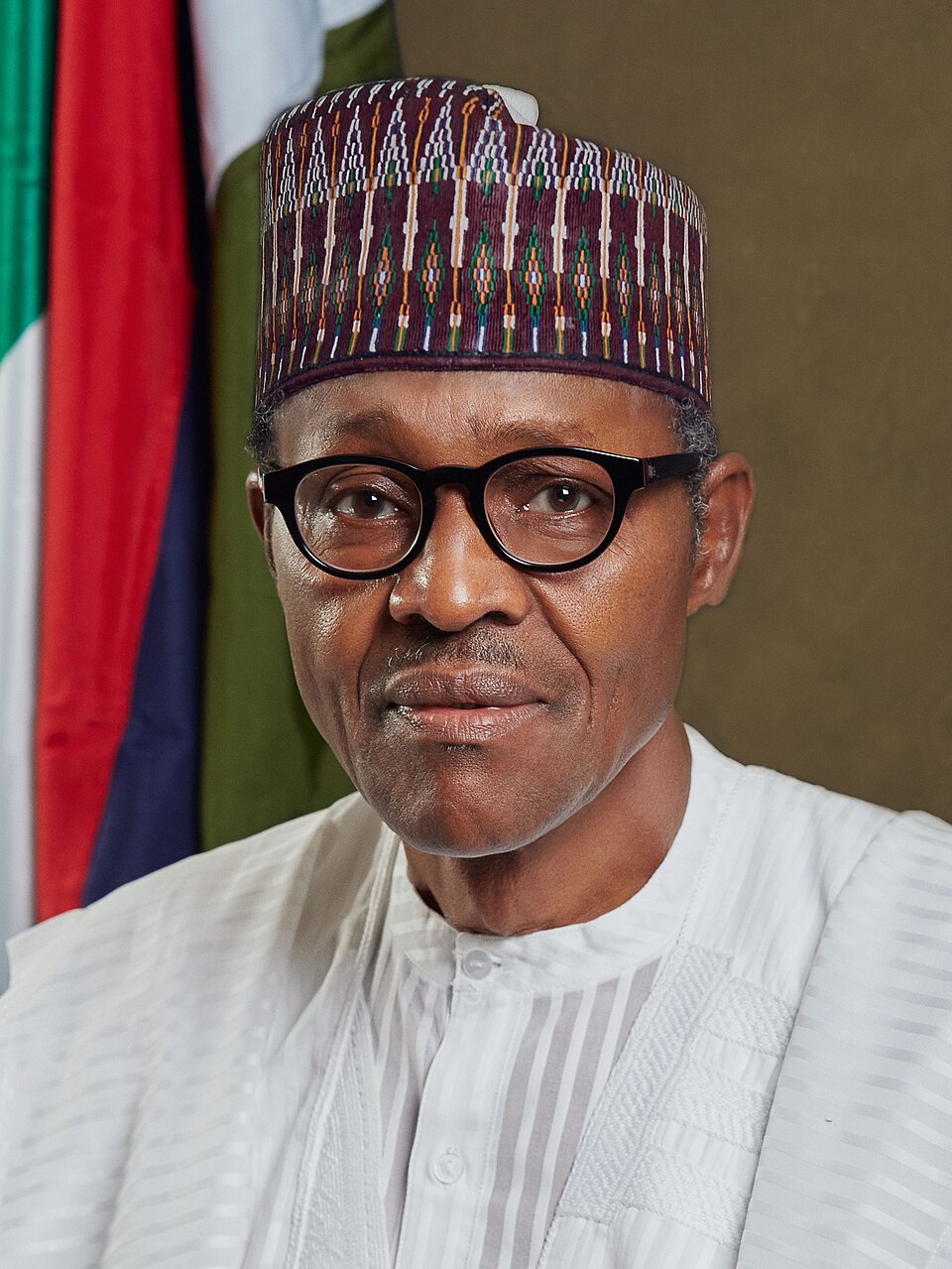 Muhammadu Buhari